Blog
Lanai Screen Installation Cost: Your 2026 Phoenix Guide
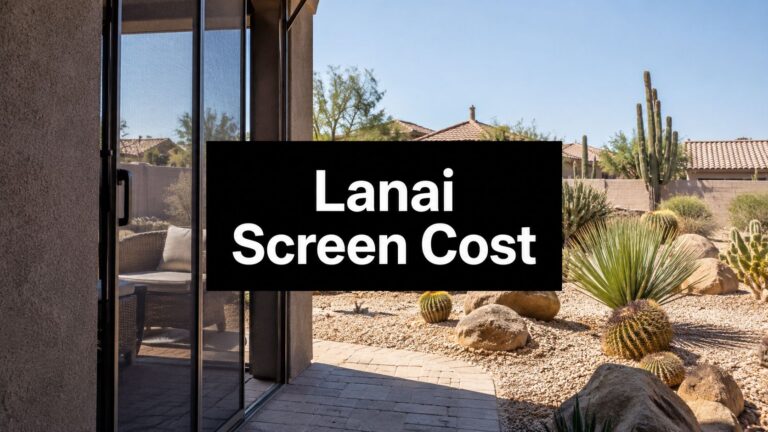
A typical lanai screen installation cost runs $10 to $25 per square foot, which puts a common 200 square foot project at $2,000 to $5,000. In Phoenix, many homeowners also see larger enclosure projects land higher, with average screen enclosure installation around $9,500 and most jobs falling between $5,000 and $14,000 depending on size and style.
If you're reading this, there's a good chance your patio is already usable for part of the year, but not for the part that matters most. You step outside in the morning for coffee, or try to sit out after sunset, and the heat, bugs, glare, or blowing debris push you back inside.
That's why screened lanais and covered patios make so much sense in the Valley. They turn a space that looks good from the kitchen window into one you'll use. The hard part isn't deciding whether screening helps. The hard part is figuring out what the job should really cost, what's included, and why one quote can look nothing like the next.
Enjoying Your Arizona Patio Year-Round
A lot of Phoenix homeowners start in the same place. The slab is there. The cover is there. Maybe the furniture is there too. But the patio still isn't comfortable enough to use the way they expected when they bought the home.
By late afternoon, the light is harsh. In the evening, insects show up. Wind carries dust across the floor, and anything lightweight gets coated. A screened lanai solves several of those day-to-day problems at once, especially when the structure is already in place and the job is focused on enclosing the open sides.
For homeowners still planning the layout, it helps to mock up the space before calling for bids. A simple patio design app can help you think through doors, furniture placement, and traffic flow before you spend money on framing or screening.
What local homeowners usually want
In Phoenix, residents typically aren't asking for a fancy add-on. They want an outdoor room that does three things well:
- Blocks insects: A screened enclosure gives you a practical barrier so the patio stays usable in the evening.
- Cuts the nuisance factor: Windblown leaves, light debris, and dust still exist, but they're easier to manage in an enclosed space.
- Makes the patio feel finished: Once the openings are screened, the area starts functioning more like a true living space.
Some homes already have the right setup for this kind of conversion. If yours does, a screen covered patio option is often much more straightforward than people expect.
A good lanai project doesn't start with mesh. It starts with how you use the patio, where the sun hits, and whether the existing frame can do the job without creating problems later.
That practical side matters more than brochure language. A simple rectangular patio with solid access is one thing. A space with odd openings, existing wear, or a mix of old and new components is another. The cost follows those realities.
Decoding Your Lanai Screen Installation Cost
Most lanai pricing works like flooring, tile, or carpet. Contractors look at the square footage, then adjust for material choice, labor, frame condition, and job complexity. If you understand that basic formula, quotes become much easier to compare.
The national baseline is clear. The national average cost to add screens to an existing lanai ranges from $2,000 to $5,000, or about $10 to $25 per square foot. For a 200 square foot lanai, that includes materials averaging $3.05 to $4.90 per square foot and labor ranging from $5.35 to $7.55 per square foot, according to industry cost breakdowns.
Where the money goes
When a homeowner hears a total number, it can sound arbitrary. It isn't. Most of the quote is tied to a few visible cost buckets.
| Cost area | What it covers |
|---|---|
| Materials | Screen mesh, spline, attachment components, and any related screening supplies |
| Labor | Measuring, prep, cutting, fitting, tensioning, installation, and cleanup |
| Structure-related work | Repairs or modifications if the existing setup isn't ready for new screening |
That's why two patios that look similar from the yard can price differently. One may be ready for clean screen installation. The other may need prep work before the first panel goes in.
A useful way to judge quotes
Homeowners often compare only the total. A better move is to compare the job definition. Ask these questions:
- Is this screen-only work on an existing structure, or does the quote include enclosure work?
- What mesh is included as the base option?
- Is the frame in condition to accept new screen without extra repair?
- Does the price include doors, hardware, or special access details?
The phrase lanai screen installation cost sounds simple. In practice, it covers everything from screening an existing covered patio to much more involved enclosure work. If you know which version you're pricing, you're already ahead of most homeowners.
Key Factors That Influence Your Final Price
The square-foot number gives you a baseline. The final price comes from the choices and conditions attached to your specific patio. In Phoenix, three factors shape most quotes more than anything else: the mesh you choose, the condition of what's already there, and how difficult the install will be.
Mesh choice changes both cost and performance
Material selection isn't just cosmetic. It affects visibility, durability, airflow, and how often the screen will need attention later.
The biggest jump usually comes when homeowners move from standard screen to heavy-duty mesh. Upgrading to pet-resistant mesh can add a 20 to 40 percent premium, with material costs moving from $20 to $30 per square foot to $25 to $35 per square foot.
That upgrade can make sense if you have dogs that push against lower panels, or if the patio sees a lot of traffic near sliders and corners. It's not always necessary, but in the right home it prevents repeat repairs.
If you're comparing options, it helps to review the common types of window screen material before deciding. The right screen for a low-traffic covered patio isn't always the right one for a home with pets, kids, or stronger sun exposure.
Existing frame condition can save you money, or eat your budget
Homeowners often focus on the new mesh and forget the skeleton holding it. That's a mistake.
If the existing structure is square, solid, and ready to accept new screening, the job stays cleaner. If the frame is loose, damaged, or out of alignment, labor climbs because installers have to fight the structure before they can finish the screen properly. A few examples make this clear:
- Best-case scenario: Existing covered patio, clean openings, sound frame, easy access.
- Middle ground: Existing structure works, but some sections need adjustment or replacement before screening.
- Higher-cost situation: Custom openings, damaged framing, multiple door inserts, or a design that needs heavier support.
Complexity is what homeowners underestimate most
Simple rectangles are cheaper to screen than patios with multiple angles, long spans, awkward transitions, or limited work access. That's true even when the square footage looks similar on paper.
The patio that looks "small" to the homeowner is sometimes the harder install. Tight corners, uneven openings, and bad access can add more labor than raw size. This is also why online calculators are only a starting point. They don't know if your patio has a clean layout or a bunch of little complications hidden behind a simple footprint. Labor follows field conditions, not just math.
DIY vs Professional Installation: A Cost-Benefit Analysis
Some lanai jobs are small enough that homeowners naturally think about doing them themselves. For a single panel or a basic repair, that instinct makes sense. But there's a difference between replacing one damaged screen and installing a full, clean, tight lanai enclosure that has to look right and hold up.
When DIY makes sense
DIY can work for small, contained tasks where the risk is low and the opening is manageable.
- One damaged panel: If the frame is intact and the screen area is easy to access, some homeowners can handle a basic replacement.
- Learning project: A utility screen or less-visible area is a safer place to learn than a front-facing patio section.
- Schedule control: You can work on your own timeline instead of waiting for a service window.
That said, many DIY jobs go sideways in the same ways. Screen gets over-tensioned, under-tensioned, wrinkled, or cut poorly around corners. Then the homeowner buys more material and does the same opening twice.
Where professional installation earns its keep
Professional work becomes more valuable as the project gets bigger, more visible, or more complicated. Full patio screening, door integration, odd shapes, and larger spans all demand cleaner measuring and tighter execution.
The hidden cost many national guides miss is the minimum service fee. Contractors often charge a flat $300 minimum, which can make a single replacement screen cost $150 to $250 even when the material itself is only $10. That cuts both ways:
| Situation | Better fit |
|---|---|
| Tiny repair with limited urgency | DIY may be more economical |
| Multiple panels or full lanai install | Professional work usually gives better value |
| Visible patio area where appearance matters | Professional work reduces redo risk |
If the job is small, the trip charge can dominate the price. If the job is large, installation quality dominates the value. That's the part homeowners in Phoenix need to hear. Calling a pro for one tiny repair can feel expensive because it is expensive relative to the material. Hiring a pro for a full lanai project is different. There, you're paying for fit, tension, clean lines, durability, and not having to redo the work.
Lanai Screen Costs in Phoenix and Surrounding Cities
Phoenix pricing has its own rhythm. National averages are useful, but local homeowners need local context. In this market, costs move based on patio size, enclosure style, and how far the project leans toward basic screening versus a more complete enclosure build.
Phoenix homeowners pay about $9,500 on average for screen enclosure installation, with most spending between $5,000 and $14,000 depending on size and style. For mid-sized lanais between 200 and 500 square feet, costs generally run $4,000 to $9,000.
What that means in the Valley
In practical terms, Phoenix-area homeowners usually land in one of these buckets:
- Smaller straightforward projects: Existing patio, simple geometry, standard screen, easier access.
- Mid-sized lanais: Often the most common jobs, especially when the covered structure is already in place.
- Larger or more customized enclosures: These move up fast when layout, style, and structural needs become more involved.
That local spread is why a quote from a national website can feel disconnected from what you're seeing in Phoenix, Scottsdale, Peoria, Mesa, or Chandler. The Valley has plenty of existing covered patios, but it also has a lot of variation in home age, patio design, and exposure to sun and wind.
Why local estimates differ from generic calculators
Online calculators assume smooth conditions. Field work doesn't. A Phoenix patio may have wide openings, older aluminum components, slider integration, or orientation that makes certain screen options a smarter long-term choice. That's part of why local estimates should account for what's present in your backyard, not just the square footage.
A local quote should explain the patio you have, not the average patio in America.
That's the standard to hold contractors to. If the estimate doesn't reflect your structure, your access, and your material choice, it's not detailed enough yet.
Beyond the Basics: Common Upgrades and Add-Ons
Once the core project is priced, most homeowners start asking about upgrades. Some are worth every dollar. Others only make sense for certain homes. The key is choosing add-ons that solve a real problem instead of just adding line items.
Upgrades that usually earn their place
Some add-ons improve day-to-day use enough that homeowners rarely regret them.
- Pet-resistant screen: Best for homes where dogs scratch, jump, or press against lower sections.
- Solar or sun-control screens: Helpful where glare and heat are the main problem, not just insects.
- Kick plates or reinforced lower sections: Smart in high-traffic areas, especially near chairs, planters, or active doorways.
- Clearer-view screen options: A better fit when the backyard view matters and homeowners don't want the screen to dominate the look.
Match the upgrade to the problem
Pet-resistant mesh is the clearest example. It costs more, but it's often cheaper than repeating repairs in the same lower panels. If pets are hard on screens, durability matters more than the lowest initial quote.
Solar-oriented screens solve a different problem. They're less about bug control and more about comfort. In Phoenix, that can be the deciding factor between a patio you admire and a patio you use during bright afternoon hours. A few practical matches:
| Problem at home | Upgrade worth considering |
|---|---|
| Dogs damaging lower panels | Pet-resistant mesh |
| Harsh western sun | Solar or sun-control screen |
| Furniture scraping screen walls | Kick plates or reinforced lower sections |
| View is the main selling point | Clear-view screen option |
Better materials don't automatically mean a better job. The right material for the way you use the patio does.
That's how homeowners should think about upgrades. Not as "premium" or "basic," but as problem-solving choices. If the add-on addresses a real issue in your home, it has value. If it doesn't, skip it and keep the project clean.
Your Project Timeline and Next Steps with Northwind Screen Co.
Most homeowners want to know two things after pricing. How long will this take, and what happens first?
For a typical lanai screening project, the process usually starts with a site visit or a detailed quote request. Then the contractor confirms measurements, reviews screen options, checks the existing structure, and schedules installation. Straightforward jobs move faster than custom or repair-heavy ones, but the sequence stays about the same.
What to expect from start to finish
- Initial contact and quote request. You describe the patio, the problem you're trying to solve, and whether this is new screening, rescreening, or repair work.
- Measurement and material selection. The contractor confirms dimensions and helps you choose the right mesh for insects, sun, pets, or general patio use.
- Installation day. Old material comes out if needed, openings are prepped, and the new screen is installed and tensioned.
- Final walkthrough. You check doors, corners, fit, and overall appearance before the job is wrapped up.
Common homeowner questions
Do contractors handle repairs and full rescreens, or only new installs?
Most screen companies handle both, but it's worth asking whether they focus on small repair work, full patio screening, or both.
How should I prepare before installation day?
Clear furniture, planters, and fragile items away from the work area so the crew can move cleanly and safely.
Should I repair one panel or rescreen multiple sections at once?
If several panels are worn, bundling the work often makes more sense than chasing one failed section at a time.
How fast can the work get scheduled?
That depends on workload, material availability, and project size. Ask up front whether the company offers quick quotes or same-week scheduling.
If you want a fast, local estimate for patio screening, repairs, rescreening, slider screens, bug screens, or sun screens, contact Northwind Screen Co.. We offer quick quotes, same-week service, and same-day pickup in the Phoenix area. Text or call 555-555-0100 to get started.
Thinking about a porch or patio rescreen?
Get a quick quote on custom screens, sun and solar screens, slider repairs, and patio rescreening. Same-week service and a lifetime guarantee.