Blog
Screen Size Calculator: A Pro's Guide for Windows & Doors
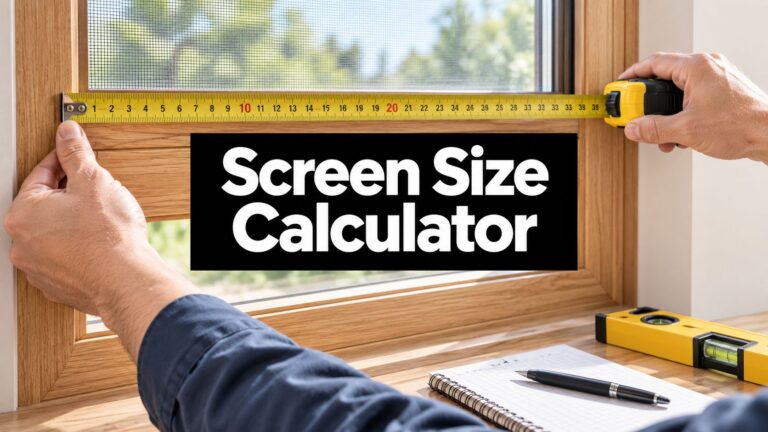
You've probably been there. You measured an old screen, placed the order, waited for it to arrive, and then found out it doesn't sit right. It binds in the frame, bows when you try to pop it in, or drops into the opening so loosely that every breeze reminds you the job went sideways.
That usually isn't a material problem. It's a measuring problem.
A lot of homeowners search for a screen size calculator and assume any calculator with that label will help. Most won't. Most online tools were built for TVs, monitors, and projection screens. They calculate display dimensions from a diagonal. That has almost nothing to do with fitting a screen into a window channel, a slider track, or a patio opening where the actual constraints are frame depth, corner squareness, latch clearance, and how much room the screen has to flex during installation.
That Perfect Fit and Why It's So Elusive
A window screen can be off by a small amount and still become a headache. Too tight, and you start forcing the frame. Too loose, and the screen rattles, shifts, or leaves visible gaps. Homeowners often think they made a simple math mistake. More often, they used the wrong measuring logic from the start.
The trap starts with the phrase screen size calculator. Online, that usually means a display calculator. Those tools are designed around standard aspect ratios and diagonal measurements, not around the physical opening in your home. Most screen size calculators ignore the non-standard aspect ratios that matter for outdoor and specialty screens, defaulting to display formats like 16:9 or 4:3 instead of the custom proportions found in sliders, patios, and other specialty openings.
That's why a homeowner can do everything "right" according to a calculator and still get a useless result.
The old screen is often a bad template
I see this mistake all the time in practice. Someone measures the existing screen because it's easy to remove and lay flat. But old screens get bent. Corners spread. Frames twist. Springs weaken. Pull tabs get replaced. If you copy a distorted part, you often reproduce the problem that made the old one fit poorly in the first place.
A screen should fit the opening you have now, not the damaged frame you pulled out.
Standard charts help, but only up to a point
If you're trying to get your bearings, a standard window screen size chart can help you understand common ranges and screen types. It won't replace measuring the actual frame. Real homes don't stay perfectly uniform, especially after years of heat, repainting, stucco work, or track wear.
That's why the perfect fit feels elusive. People are using a digital-display mindset for a hardware-fitting job. Once you switch from calculator logic to opening logic, the process gets much more reliable.
Why a TV Screen Calculator Will Ruin Your Project
A TV calculator answers one question. If I know the diagonal, what are the width and height of the visible display?
A window or door screen requires a different question. What are the exact physical dimensions of the opening, and what hardware constraints affect insertion and retention?
Display math is not frame math
For modern displays, the industry standard uses the Pythagorean theorem with a 16:9 aspect ratio. In that system, width equals the diagonal multiplied by about 0.8716, and height equals the diagonal multiplied by about 0.4903. That's useful when you're comparing a TV, monitor, or laptop.
It's useless for a window frame. A display calculator assumes the diagonal measurement tells you the shape. That works because the display follows a fixed ratio. A home screen opening doesn't. It may be close to square, tall and narrow, wide and short, or slightly out of square from settling or wear. There is no universal aspect ratio for a bathroom window, a patio opening, or a sliding screen door.
Viewable area and frame opening are different things
A TV measures the viewable area from corner to corner. A window screen has to fit inside a frame, ride in a channel, clear corners, and stay retained by springs, tabs, or rollers. Those are physical constraints, not visual ones. Here's a clearer perspective:
| Measurement type | What it describes | Why it fails or works |
|---|---|---|
| TV calculator | A display's visible rectangle based on diagonal and aspect ratio | Doesn't account for tracks, frame depth, hardware, or squareness |
| Home screen measurement | The actual opening and the screen's fit inside that opening | Matches how the part is installed and used |
Generic calculators hide the expensive part
The expensive part of a bad screen order usually isn't the mesh. It's the time, the repeat trip, the rework, and the frustration. That's the same reason contractors pay attention to measuring discipline in other trades.
If the tool starts with a diagonal, it was probably built for electronics, not for your house.
A proper measurement process starts with the opening, not the screen category. That's the difference between getting close and getting a part that fits.
The Professional's Guide to Measuring for Screens
Good screen measuring isn't complicated. It's careful. The biggest difference between a clean install and a frustrating one is usually whether you measured the opening itself, checked for squareness, and wrote everything down in a consistent way.
The professional approach lines up with a broader sizing framework: measure the usable space, account for frame depth or buffers, confirm the right proportions, and verify compatibility with the existing frame or opening. For home screens, that translates into a simple shop-floor routine.
Find your true opening
Don't start with the old screen. Start with the frame where the new one has to live. For a standard window screen, measure the width inside the channel where the frame sits. Then measure the height the same way. Take each measurement in more than one spot because openings aren't always uniform. Use this sequence:
- Width at the top: Check the inside edge where the screen frame seats.
- Width at the middle: This often catches slight bowing in older frames.
- Width at the bottom: Paint buildup and track wear often show up here.
- Height on the left and right: Side channels can vary more than people expect.
If those numbers differ, the smallest practical dimension usually matters most because the screen still has to go in without binding.
Measure corner to corner
Diagonal checks tell you whether the opening is square enough for a rigid frame to fit cleanly. If one diagonal is noticeably different from the other, the opening may be racked. That doesn't always mean the job stops. It means you need to know a standard square frame may seat tightly at one corner and gap at another.
That diagonal check is one of the most skipped steps in DIY measuring, and it explains a lot of "it should fit on paper" problems.
Account for the hardware
A screen frame doesn't float in space. Springs compress. Pull tabs need clearance. Some channels are deeper than they look. On sliders, wheel assemblies and top guides change how much insertion room you have. On windows, the frame lip can steal space from what seems like the obvious opening. That's why usable opening matters more than visible opening.
Record with precision
Write width first, height second, every time. Stay consistent. If you switch the order on even one note, you can easily flip dimensions on the final order. A simple field note sheet works well:
| Opening | Width readings | Height readings | Diagonals | Notes |
|---|---|---|---|---|
| Kitchen window | top, middle, bottom | left, center, right | both corners | springs, tabs, frame depth |
| Bathroom window | top, middle, bottom | left, center, right | both corners | paint buildup, tight corner |
| Slider | top track, middle, bottom track | left and right | opening check | rollers, latch side, guide clearance |
Don't chase false precision. Clean, repeatable measurements matter more than writing down extra tiny fractions if the frame itself isn't perfectly true. The goal is a screen that installs cleanly and stays put, not a notebook that looks technical.
Common Measurement Mistakes to Avoid
Most bad screen orders follow a pattern. The same errors keep showing up because they feel harmless when you're standing at the window with a tape measure. They aren't harmless. Ignore the critical measurements, and the end result disappoints.
Five mistakes that cause most fit problems
Measure twice, order once.
- Measuring the old screen instead of the opening: Old frames bend, spread, and wear out. If the existing screen has any twist at all, you're copying damage.
- Skipping the diagonal check: A rectangular opening can still be out of square. If you don't check corner to corner, you won't see the problem until install day.
- Ignoring hardware clearance: Springs, tabs, latches, rollers, and frame lips all affect fit. A raw opening dimension doesn't tell the whole story.
- Confusing width and height in your notes: This sounds basic, but it happens constantly on multi-window jobs. Standardize your note-taking.
- Writing messy field notes: If you can't tell which window the numbers belong to, the numbers aren't useful.
The hidden mistake is overconfidence
Homeowners often get into trouble after one easy measurement goes well. The first screen fits, so the rest of the house gets measured faster and sloppier. That's where mixed dimensions, skipped diagonals, and missed obstructions creep in. A better rhythm is simple:
- Measure the opening.
- Check it again from another position.
- Label the opening clearly.
- Note anything unusual before ordering.
The job rarely fails because the tape measure was wrong. It fails because someone assumed the opening was standard when it wasn't.
Careful measuring feels slower at the window. It's much faster than reordering.
Measuring for Sliders, Patios, and Horse Stalls
Standard windows are the easy jobs. Large openings and specialty applications are where generic advice completely falls apart.
Sliders need track measurements, not guesses
A sliding screen door has to move, stay aligned, and clear its hardware. That means the top and bottom tracks matter as much as the visible opening. You need to know how the screen enters the track, how much play the rollers have, and whether the latch side needs extra attention. If you only measure face to face, you can end up with a door that technically matches the opening but won't roll correctly.
Patios need structure-aware measuring
Patio screens bring a different problem. The opening is bigger, the frame may not be perfectly uniform, and mesh tension becomes more noticeable across wider spans. Spline placement, support layout, and how the frame is anchored all affect the final fit. For project-specific work, our patio screen and rescreening service gives a clearer picture of the kinds of openings and rescreening situations homeowners usually deal with.
Horse stalls are functional screens, not just insect screens
A horse stall screen isn't judged the way a kitchen window screen is. The priority is the job it performs. Airflow, shade, durability, and visibility all matter. A specialty screen has to be sized for its primary function, not by a one-size-fits-all formula.
A patio opening wants structural accuracy. A slider wants track compatibility. A horse stall wants function first.
Those aren't minor differences. They change how you measure from the start.
For a Perfect Fit, Guaranteed, Call the Pros
By now, the pattern is clear. A generic screen size calculator is usually built for electronics. Your home screen project depends on physical measurements, opening conditions, hardware clearance, and whether the frame is square.
That's why some screen jobs go smoothly and others turn into repeat orders. The measuring itself isn't mysterious. It just has to be done with discipline. Measure the opening, not the old part. Check multiple points. Verify diagonal. Account for tracks, springs, tabs, and frame depth. Treat sliders, patios, and specialty screens as their own categories.
After all this, ask the practical question. Do you want to risk the time, money, and frustration of getting it wrong? For many homeowners, the smartest move is handing the final measurement and build to someone who does this work every day. That takes the guesswork out of the process and avoids the most common fit problems before they happen.
If you want a screen that fits right the first time, contact Northwind Screen Co.. We handle new screens, rescreening, repairs, sliders, patio screens, bug screens, and sun screens with quick quotes, same-week service, and same-day pickup. We serve homeowners across Arizona, including Phoenix, Scottsdale, and Peoria. Text or call 555-555-0100 to get started.
Thinking about a porch or patio rescreen?
Get a quick quote on custom screens, sun and solar screens, slider repairs, and patio rescreening. Same-week service and a lifetime guarantee.