Blog
Solar Screens for Windows Cost: Phoenix Guide 2026
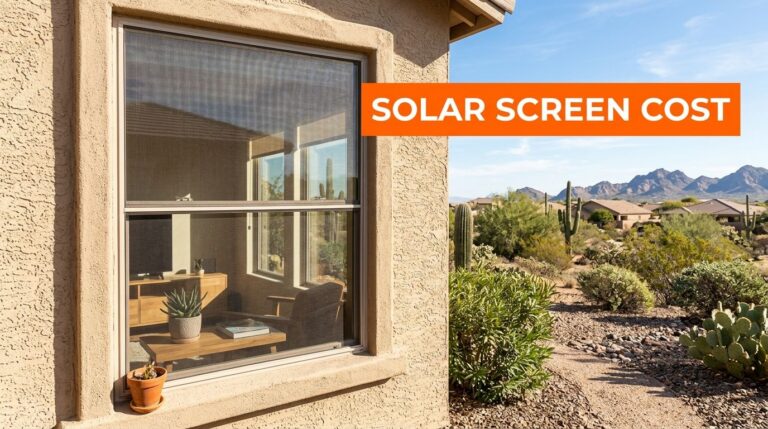
In Phoenix, most homeowners should expect to pay $8 to $12 per square foot for professionally installed solar screens, or roughly $200 to $500 per window. That's higher than many national averages, but it reflects what it takes to hold up against desert sun, long cooling seasons, and monsoon exposure.
If you're reading this after opening a summer power bill and wondering whether solar screens are worth it, you're asking the right question. In the Valley, west-facing glass can turn a living room into a heat trap by late afternoon, and bare windows force your AC to fight that heat every day.
That's why the discussion isn't just about sticker price. It's about what you're buying for that money: less glare, cooler rooms, better comfort near windows, and a chance to cut the strain on your cooling system. Nationally, the average installed cost for exterior solar screens is around $160 per window, with a typical range of $80 to $280 depending on size, material, and labor complexity. Phoenix pricing usually lands above that because our climate is harder on both materials and installers.
Beating the Arizona Heat and Your High Energy Bill
Phoenix heat exposes weak windows fast. The rooms that get afternoon sun are usually the first problem. You feel it on the floor, on the couch, and standing a few feet from the glass, even when the AC is running.
That is why homeowners here ask about solar screens in the first place. The main issue is not just shade. It is reducing solar heat before it pushes into the house and makes your system work harder for the same indoor temperature.
In the Valley, west-facing and south-facing windows do most of the damage. Blinds help with glare, but once sunlight passes through the glass, much of that heat is already inside. Exterior solar screens address the problem at the window instead of trying to manage it after the room has heated up. From a practical standpoint, the benefit shows up in three places:
- Rooms stay more usable in the late afternoon.
- Glare drops without having to keep every blind shut.
- Your AC has less heat to fight during the longest cooling months.
I see the biggest difference on homes with large panes of uncovered glass, older windows, and rooms that never seem to match the thermostat setting. In those cases, solar screens are often one of the simpler exterior upgrades that can improve comfort without replacing the windows themselves.
Phoenix also changes the buying decision. Homeowners here are not comparing solar screens against a mild-climate baseline. They are comparing them against long summers, high peak electric rates, and windows that take direct desert sun day after day. That is what makes the cost question local. You are paying for a product that needs to hold tension, fit correctly, and keep performing through heat, dust, and monsoon weather. Cheap screens can still cast shade. The trade-off is usually shorter life, looser fit, or weaker frame and fabric performance after a few hard seasons. In Arizona, those details matter.
Typical Solar Screen Costs in the Phoenix Area
A Phoenix quote usually makes more sense once you stop looking for one magic number. Screen shops price by opening size, frame type, fabric, access, and how many windows are on the order. The result is a range, not a flat sticker price.
What local quotes usually look like
In practice, most Phoenix homeowners see quotes built around three buckets: small standard windows, larger living-area windows, and custom or hard-to-reach openings. A basic bedroom window on a single-story home will usually price lower than a tall foyer window, an oversized slider screen, or anything that needs custom fabrication.
That matters here because Phoenix homes often have a few windows that do most of the heat-loading work. The west-facing family room and the big south-facing panes are usually the expensive ones to screen, but they are also the ones where the comfort payoff shows up fastest.
A better way to budget the project
Instead of asking, "What does one screen cost?" start with, "Which windows are causing the problem?" That is how a lot of local pros build a practical quote.
| Project scope | What it usually includes | Cost framing |
|---|---|---|
| Priority heat-control package | The hottest west- and south-facing rooms | Lowest starting cost, fastest comfort improvement |
| Main living area package | Family room, kitchen, primary bedroom, exposed secondary bedrooms | Balanced option for comfort and appearance |
| Whole-home sun exposure package | Most or all exterior windows that take direct sun | Higher upfront cost, more uniform exterior look |
That approach keeps the budget tied to results. If two upstairs windows turn that side of the house into an oven every afternoon, those are the first screens worth buying.
What is included in the finished price
A finished quote is not just mesh in a frame. It usually includes measuring, fabricating the screen to fit the opening, frame material, corners and hardware, installation, and a service margin if adjustments are needed after install.
Material choice changes the number, too. Denser fabric can improve shade and glare control, but it can also darken the room more. Heavier frame packages hold up better on larger openings, especially in high sun and monsoon conditions, but they cost more than a light basic build. If you want to compare openness levels and fabric trade-offs before you request bids, our sun and solar screen options are a useful reference.
For homeowners comparing this project to other home services, quoting works like most home-service pricing. The final bill depends on scope, access, complexity, and whether the work is standard or custom.
Phoenix pricing is local for a reason
National averages can point you in the right direction, but they do not capture how hard Arizona sun is on materials or how much value homeowners here place on lowering afternoon heat gain. In this market, fit and durability matter. A loose screen, a weak frame, or the wrong fabric percentage can turn a decent-looking purchase into a short-lived one. That is why the cheapest bid is not always the low-cost option over time. In Phoenix, a good quote should reflect the actual conditions the screen has to survive.
Key Factors That Influence Your Final Price
In Phoenix, two houses on the same street can end up with very different solar screen quotes. The reason is usually not the window count. It is the mix of fabric, frame strength, access, and whether the job is a straightforward fit or a custom build for harsh sun exposure and tricky openings.
Fabric choice changes both cost and performance
Fabric percentage is one of the first things I look at on a quote. In Phoenix, that choice affects more than appearance. It changes how much afternoon heat you block, how much glare stays out of west-facing rooms, and how dark the interior feels during the day.
Higher shade percentages can make sense on the hardest-hit sides of the house, especially where the summer sun pounds the glass for hours. But more blockage is not always better. Some homeowners want stronger heat control in family rooms and bedrooms, while others want to keep a brighter look in front rooms or kitchens. If you want a clear breakdown of those trade-offs before you start comparing bids, our solar screen options are a good place to start.
Installation details move the labor number
Labor changes with the conditions on site. Ground-floor windows with open access are faster to measure, build for, and install. Second-story windows, deep recessed openings, older frames, or areas blocked by tile roofs, shrubs, or security bars take more time and raise the quote. That is normal.
A good installer is pricing the work involved, including adjustments needed to get each screen sitting tight and clean in the opening. In Arizona, that matters. A loose fit or undersized frame will show up fast once the screen starts dealing with constant UV, wind, and monsoon season dust.
What usually pushes a quote higher
These are the factors that most often increase the final price:
- Larger windows: Bigger openings require more mesh and stronger frame support.
- Custom shapes: Arched, angled, or oversized windows take more shop time than standard rectangles.
- Heavier frame options: Thicker frames and upgraded hardware hold up better on larger spans and exposed elevations, but they cost more.
- Access challenges: Upper-story installs and windows above landscaping, patios, or rooflines add labor.
- New builds versus rescreens: Reusing an existing frame can save money if that frame is still square and worth keeping. If it is bent, faded, or weak, replacing it is usually the better long-term call.
Ask each company what fabric density, frame type, and installation conditions are included in the number they give you. That is how you compare quotes fairly in the Phoenix market.
DIY Installation vs Hiring a Professional Service
A Phoenix homeowner can save money with DIY screens on a few simple windows. The same project can turn expensive fast if one screen is cut wrong, one frame sits loose, or a second-story install goes sideways in 110 degree heat.
Where DIY makes sense
DIY fits best on ground-level windows with straightforward rectangular openings, especially if you already handle small home projects and measure carefully. If the goal is to screen one or two sun-heavy windows first, doing it yourself can be a practical test before committing to the whole house.
The part many homeowners underestimate is tolerance. Solar screens do not need cabinet-grade precision, but they do need to fit tight, sit square, and hold tension. In our climate, small flaws show up quickly. A loose corner rattles in monsoon wind. A weak frame starts to bow on a wide opening. A screen that looks acceptable in the garage can look crooked from the street once it is installed.
Why professional installation often pays off
Professional work starts to make more sense when the job involves multiple elevations, mixed window sizes, or older homes where the openings are not perfectly square. That is common in Phoenix neighborhoods with aging stucco exteriors and years of sun exposure.
You are also paying for consistency. A good installer matches frame color, mesh type, hardware, and fit across the house so the front elevation looks clean instead of patched together. On larger homes, that matters almost as much as the heat reduction. Professional installation is usually the better call for:
- Second-story or hard-to-access windows.
- Wide openings that need stronger frame support.
- Older windows with slight variation from opening to opening.
- Whole-home projects where appearance matters.
- Homeowners who want the job finished before the next stretch of extreme heat.
Side-by-side tradeoff
| Choice | Best for | Watch out for |
|---|---|---|
| DIY | A few standard, ground-level windows | Bad measurements, wasted material, uneven fit, more weekend time than expected |
| Professional | Full-house jobs, custom sizing, upper-story access, uniform exterior finish | Higher upfront bill |
I usually tell neighbors to be honest about the actual goal. If the goal is the lowest cash outlay on a small, simple project, DIY can work. If the goal is long-term fit, fewer callbacks, and a clean look across the house, hiring it out is usually the better value in Phoenix.
Calculating Your Return on Investment and Energy Savings
A Phoenix homeowner usually feels the payoff before they finish the math. The west-facing bedroom stops heating up at 5 p.m. The AC runs less in the evening. July feels a little more manageable.
Why denser fabric can produce better payback
In Phoenix, payback usually comes from controlling the worst heat gain first. That is why 90% mesh often makes sense on west and south exposures. It blocks more sun before it hits the glass, which is what matters during long stretches of triple-digit weather.
Some analyses of solar screen performance suggest cooling bill reductions in the 25% to 30% range in certain cases, with higher-performance screens sometimes offsetting their added cost within 2 to 3 summers. Results vary by house, window orientation, insulation, thermostat settings, and how much unshaded glass you have. In my experience, the strongest savings show up on rooms with heavy afternoon sun, especially if the windows are large and exposed.
A practical Phoenix way to estimate ROI
Start with the windows that punish your cooling system the most. A house with ten windows does not always need the same screen on all ten. Use these three checks:
- Target the hottest exposures first. West-facing glass usually gives the fastest return in Phoenix. South-facing windows can also justify a stronger mesh, especially with little shade.
- Factor in comfort, not just the power bill. If a living room, home office, or primary bedroom becomes usable all afternoon, that has real value even if you never calculate an exact dollar figure.
- Compare the upgrade cost, not just the total job cost. If stepping up from a lighter screen to a denser one is a modest price jump on a few problem windows, the better-performing option often makes more sense over time.
On Phoenix homes, the best return usually comes from fixing the hottest rooms first.
Where homeowners miscalculate
I see two mistakes all the time. The first is going too light on mesh because they are worried about losing too much daylight. Then the rooms with the biggest heat load stay warm, and the expected savings never really show up.
The second is paying for maximum shading on every window without considering orientation. North-facing windows often do not need the same level of protection as west-facing glass. A mixed approach usually gives the better balance of cost, comfort, and visibility.
Lowering Your Net Cost with Local Utility Rebates
A lot of homeowners stop at the quote and never check whether they can bring the number down. That's a mistake. In some markets, local utility rebates can reduce solar screen costs by 10% to 20% or more. For Phoenix-area residents, that means it's worth checking current programs with your utility before you approve the job.
How to approach SRP and APS rebate research
Programs change, so the practical move is to verify current requirements directly with your provider before installation. When you review rebate pages, look for the parts many homeowners skip:
- Eligible product requirements: Some programs only apply to certain screen performance levels or approved product categories.
- Installation documentation: Keep invoices, screen specifications, and any paperwork showing window area or product details.
- Application timing: Some utilities want forms submitted within a specific time after installation.
- Proof of purchase detail: A vague receipt may not be enough if the program requires itemized product information.
A simple net-cost framework
Use this sequence when you compare quotes:
- Start with the full installed price for the project.
- Check current utility eligibility before work begins.
- Confirm the invoice will include the details needed for a rebate submission.
- Subtract any approved rebate amount from the installed cost to understand your true out-of-pocket number.
That sounds basic, but plenty of homeowners miss savings because they only ask, "Do you offer rebates?" instead of, "What exact paperwork will I need to claim one?" If you want the rebate, treat documentation like part of the job itself. Don't wait until after installation to figure out what paperwork the utility wanted.
The practical takeaway is this: the quoted price isn't always the final price. If you're in SRP or APS territory, a few minutes of rebate research can change the math enough to make the project easier to justify.
Your Solar Screen Questions Answered
A few questions come up on nearly every solar screen job in Phoenix, and they usually have less to do with price than with daily living after the screens are installed.
Will solar screens make the house too dark?
They can reduce incoming light, yes. Whether that feels good or bad depends on room use and fabric density. In TV rooms, bedrooms, and west-facing living spaces, many homeowners like the added shading. In areas where you want brighter natural light, a lighter screen choice often feels better.
Do they block the view?
From inside, quality solar screens usually soften the view more than they destroy it. You still see out, but the outside scene looks more filtered. During the day, many people stop noticing the screen after a short adjustment period.
How do you help them last longer in Arizona?
Desert dust and monsoon residue wear on everything outside, so basic maintenance matters. Keep it simple:
- Brush off loose dust before it packs into the mesh.
- Rinse gently with water instead of blasting the screen hard.
- Check frame corners and attachment points after storm season.
- Look for sagging or tears early so a small repair doesn't become a full replacement.
Can solar screens damage windows or cause warranty issues?
That depends on the window manufacturer and how the screens are mounted. Before installing, it's smart to review your window paperwork and ask whether exterior accessories affect coverage. A properly fitted screen generally needs to sit securely without stressing the window frame.
If you're unsure, ask two questions before ordering: how the screen mounts, and whether the frame or clips contact any part of the window system in a way your manufacturer restricts. That quick check can save you a headache later.
If you want a straight answer for your home instead of a generic online range, Northwind Screen Co. can help with quick quotes, new solar screens, rescreening, and repair across the Phoenix area. Call or text 555-555-0100 to compare options, ask about screen material choices, and get a no-pressure estimate based on your actual windows.
Thinking about a porch or patio rescreen?
Get a quick quote on custom screens, sun and solar screens, slider repairs, and patio rescreening. Same-week service and a lifetime guarantee.